If your kitchen feels tight, you are not imagining it. In newly built single-family homes, kitchens average around the size of a modest bedroom, which is why smart visual choices matter so much.
The good news is you can make a small kitchen feel bigger without adding square footage by using light, clean lines, and a better storage strategy.
Below, SB Remodeling shares practical design rules and upgrade ideas we use every day, so you can get a more open, brighter kitchen that still works hard for real life.
The Simple Visual Rules That Make a Small Kitchen Feel Larger
A small kitchen looks larger when your eye can travel without stopping. That usually comes down to three principles:
- Light wins. More reflected light makes surfaces feel farther away.
- Fewer breaks in the line. Continuous colors and long, clean runs keep the space calm.
- Hidden function. The more you can store behind closed doors, the more breathable the room feels.
You can apply these rules with weekend-level updates, or you can bake them into a remodel plan for a true transformation.
Declutter First: Remove Visual Noise That Shrinks the Room
Before you buy anything, remove what is visually loud. Countertops packed with appliances, spice racks, and mail make even a decent layout feel cramped.
Try this quick reset:
- Clear the counter to “daily only.” Keep one coffee item, one cooking oil, and one utensil crock at most.
- Group what must stay out. Put soap, sponge, and hand lotion on a small tray so it reads as one object.
- Use vertical space inside cabinets. Add risers, shelf inserts, and stackable bins so you can store more without overflow.
A minimalist kitchen is not about being sterile. It is about giving your eyes fewer things to process so the room feels calmer and larger.
Use Light Colors the Right Way (Walls, Cabinets, and Trim)
Light colors work best when they are intentional, not when everything is the same shade of white. A small kitchen looks larger when light tones bounce across multiple surfaces, and the transitions feel soft.
A simple approach:
- Walls: Choose a warm white or light neutral so the room does not feel cold.
- Cabinets: If you are going white, pick a cabinet white that matches the undertone of the wall paint (warm with warm, cool with cool).
- Trim and ceiling: Keep them slightly brighter than the walls to lift the ceiling visually.
If you want help comparing door styles, cabinet colors, and finish samples in one place, explore the SB Showroom to narrow down a palette that brightens the space without looking flat.
Cabinet Tricks: Go Taller, Cleaner, and More Continuous
Cabinetry is where small kitchens either tighten up or finally exhale. The goal is to reduce visual breaks and push the eye upward.
Design moves that consistently make a small kitchen look larger:
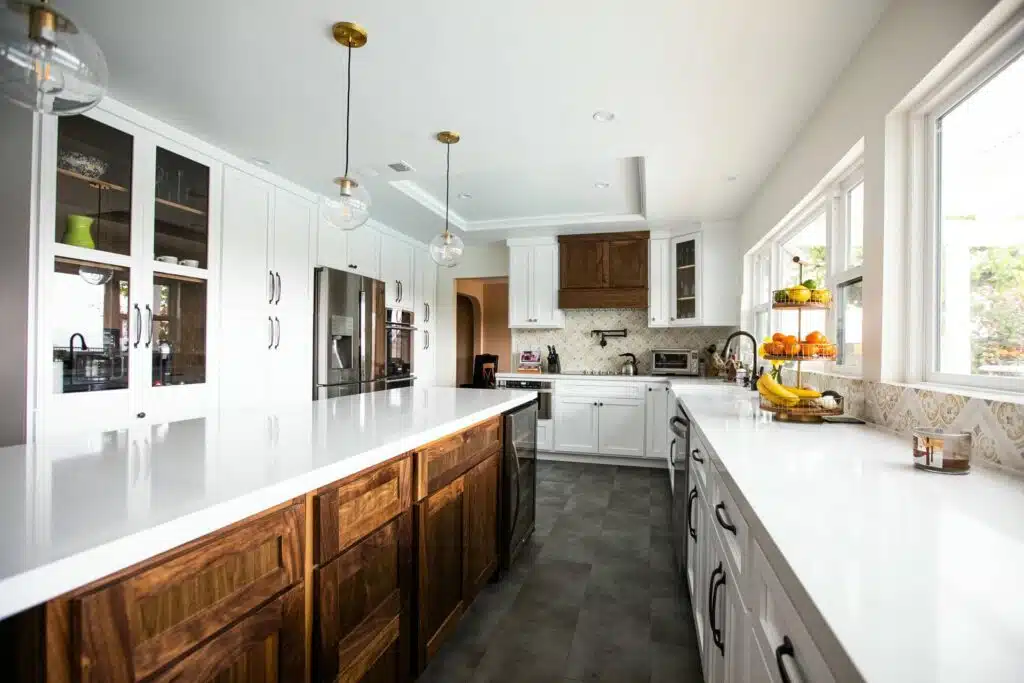
- Go to the ceiling. Taller uppers reduce the dusty gap at the top and add storage without adding bulk.
- Choose simpler door profiles. Slab or clean Shaker doors read quieter than ornate profiles.
- Minimize hardware. Smaller pulls, edge pulls, or consistent hardware throughout keeps the look unified.
- Create long runs when possible. A continuous cabinet line looks more expansive than multiple short segments.
Even if you are not replacing cabinets, refinishing or refacing can still achieve a cleaner, more continuous look.
Lighting Upgrades That Instantly Open the Space
Lighting is one of the fastest ways to make a small kitchen feel bigger because it changes how every surface reads.
Layer your lighting like this:
- Ambient: Recessed or a clean, low profile ceiling fixture to fill the room.
- Task: Under cabinet lighting to eliminate shadowy counters.
- Accent: A small pendant over a sink or peninsula, scaled to the space.
Tips that keep it feeling open:
- Use fewer, brighter sources rather than many small, dim fixtures.
- Put lights on dimmers so the kitchen can shift from cooking mode to hosting mode.
- Choose fixtures with slim silhouettes that do not visually crowd the ceiling line.
Mirrors and Reflective Surfaces That Actually Work in Kitchens
Mirrors can work in kitchens, but the key is using reflective materials that feel natural and easy to maintain.
Good options for a small kitchen:
- Glossy backsplash tile that reflects light softly without looking like a literal mirror wall.
- Polished stone or quartz that brightens the countertop line.
- Glass cabinet doors in a limited section (like one upper run) to add depth.
Skip anything that becomes a fingerprint magnet in high touch zones. In kitchens, “reflective” should still be practical.
Backsplash and Countertop Choices That Create One Clean Line
A small kitchen feels bigger when the backsplash and countertop read as one long, clean line.
Consider these visual upgrades:
- Light backsplash, light grout. High contrast grout creates a grid that can visually chop up the wall.
- Full-height backsplash in key areas. Taking the backsplash to the bottom of uppers (or all the way up in one feature zone) can make the wall feel taller and more finished.
- Simple countertop edge profiles. Busy edges add visual clutter. Clean edges feel modern and expansive.
If you want the room to look bigger, avoid too many competing patterns. Pick one “hero” surface, then keep everything else quiet.
Flooring and Visual Continuity: Make the Room Feel Longer and Wider
Flooring has a huge impact on perceived space because it is the largest uninterrupted surface in most kitchens.
To stretch the room visually:
- Use fewer seams. Larger format tile or wider plank flooring reduces visual breaks.
- Keep the tone lighter. Light wood looks and soft neutrals tend to open up the footprint.
- Continue the same flooring into adjacent spaces if your layout allows. That continuity makes the kitchen feel like part of a larger zone, not a boxed-in room.
If replacing flooring is not in the budget, a well-chosen runner can still help by leading the eye along the length of a galley or walkway.
Window Treatments: Let Light In Without Losing Privacy
Natural light is your best friend in a small kitchen. Heavy drapes or dark blinds can make the room feel compressed.
Better choices for small kitchens:
- Sheer curtains for soft privacy while still letting light through.
- Roman shades in a light fabric for a clean, tailored look.
- Top-down shades if you want privacy without blocking daylight.
Keep the hardware minimal and mount treatments higher when possible to make the window feel taller.
Open Shelving vs Upper Cabinets: When Each One Makes a Space Feel Bigger
Open shelving can make a small kitchen feel bigger, but only if you can keep it curated.
Choose open shelving when:
- You have a limited set of matching dishes or glassware.
- You want the wall to feel lighter than a full run of uppers.
- You are okay maintaining the look daily.
Keep upper cabinets when:
- You need real storage for busy households.
- You have lots of packaging, appliances, or mixed items.
- You want the cleanest possible visual line.
A balanced approach often works best: one open shelf zone, with the rest closed storage.
Smart Storage That Hides the Mess Without Adding Bulk
Storage is what keeps a small kitchen functional, but it has to be the right kind of storage. You want solutions that disappear, not bulky add-ons that crowd the room.
High-impact storage upgrades:
- Pull out trash and recycling.
- Pull out pantry shelves for narrow gaps.
- Deep drawer organizers for cookware.
- Corner cabinet solutions that actually access the back space.
- Toe kick drawers for flat items like baking sheets.
When the mess is hidden, the room looks larger because the surfaces stay clear.
Appliance and Sink Sizing: Right-Scale Choices That Free Up Space
In a small kitchen, oversized appliances steal both walkway clearance and visual breathing room.
Space-saving choices that still feel premium:
- Counter depth refrigerators for a more flush, built-in look.
- Slim profile ranges when you do not need a wide cooktop.
- Single bowl sinks if you want a cleaner look and more usable basin space.
If you are replacing fixtures anyway, choosing right-scale pieces can make the whole kitchen feel less crowded overnight.
Layout Tips: Improve Flow Without Moving Plumbing
You can improve how a small kitchen feels, even if you keep the same basic plumbing locations. The goal is to reduce bottlenecks and protect a clean circulation path.
Try these layout tweaks:
- Remove or reduce anything that blocks the main walkway.
- Shift storage so daily items live closest to where you use them.
- Replace a bulky table with a slim peninsula or wall-mounted fold-down surface.
- Use a consistent cabinet line to avoid zig-zag corners that eat space.
If your kitchen feels closed off from the rest of the home, widening an opening or adjusting how the kitchen connects can make it feel dramatically larger, even if the footprint stays the same.
Use Glass, Light Materials, and Minimal Hardware for an Airy Look
An airy kitchen is not about having less. It is about choosing materials that feel visually light.
Quick wins:
- Glass pendants or clear shades instead of heavy metal fixtures.
- Light, matte finishes that reduce glare while still brightening the space.
- Matching hardware finishes so nothing looks chaotic.
When everything is cohesive, your kitchen reads as a single space, not a collection of parts.
Styling Tricks: Rugs, Art, and Decor That Add Space, Not Clutter
Decor can help a small kitchen feel bigger when scaled correctly.
Keep it simple:
- Choose one piece of art rather than many small items.
- Use a runner to elongate the floor line.
- Keep countertop decor minimal and intentional.
- Add one living element, like a small plant or a bowl of fruit, then stop.
The goal is to add warmth without adding noise.
Quick Weekend Upgrades vs Bigger Remodel Moves
If you want the fastest impact, start with:
- Decluttering and organizing drawers.
- Swapping bulbs for brighter, modern lighting.
- Adding under-cabinet lighting.
- Painting walls a lighter neutral.
- Replacing a busy backsplash with something cleaner.
If you are ready for a bigger change, a remodel can combine multiple space-making moves at once, such as taller cabinets, layered lighting, improved storage, and a more open connection to adjacent rooms. For inspiration, browse SB Remodeling projects to see how small kitchens can be transformed into brighter, more functional spaces.
When It’s Time to Remodel: Changes That Create Real Space
Sometimes a kitchen still feels small because the layout is working against you. That is when it is worth exploring remodel-level solutions:
- Reworking cabinet runs to create a longer, cleaner line.
- Expanding openings to adjacent living or dining areas.
- Upgrading storage so countertops can stay clear.
- Integrating right-scale appliances for better clearance.
- Redesigning lighting so the room is evenly bright, not patchy.
If you want to talk through options without guessing, you can schedule a virtual consultation with SB Remodeling to get expert input on what will make the biggest difference for your specific space.
A Bigger-Looking Kitchen Comes Down to Light, Lines, and Less Clutter
A small kitchen can feel bigger when light is layered, surfaces stay clean, and the design avoids visual breaks. Start with decluttering, brightening, and continuity, then upgrade storage and finishes as budget allows. If you are ready to plan the next step, visit the SB Showroom for finish inspiration, or contact SB Remodeling to discuss your kitchen goals.
Short takeaway: Brighten the space, simplify the visual lines, and hide the clutter. Those three moves consistently make a small kitchen feel larger, whether you are doing quick upgrades or planning a full remodel.
FAQs
- How can I make my small kitchen space look bigger without major renovations?
Utilizing light colors, strategic lighting, mirrors, and decluttering can vastly improve the perception of space. Also, choosing scaled-down appliances and furniture can make a significant difference. - What are the best colors to use in a small kitchen to make it appear larger?
Light hues like soft whites, light grays, and pastels can open up a space. These colors reflect light better, making the kitchen feel airy and more spacious. - How do I choose lighting for a small kitchen?
Opt for a combination of natural and artificial lighting. Under-cabinet lights, pendant lights, and strategically placed spotlights can enhance the kitchen’s overall brightness and create an illusion of space. - Are open shelves a good idea in a small kitchen?
Yes, open shelving creates an open, airy feel. They provide storage without the visual bulk of closed cabinets and are great for displaying decorative items or everyday dishes. - How can I use mirrors effectively in kitchen design?
Place mirrors where they can reflect natural light or your kitchen’s lighting. This can be near a window or opposite to your lighting fixtures. Mirrors can also be used as a backsplash to create a sense of depth. - What are some minimalist design tips for small kitchens?
Focus on simplicity and functionality. Choose flat-panel cabinets, simple hardware, and a minimal color palette. Keep decorations to a minimum and only have essential items on the countertops.