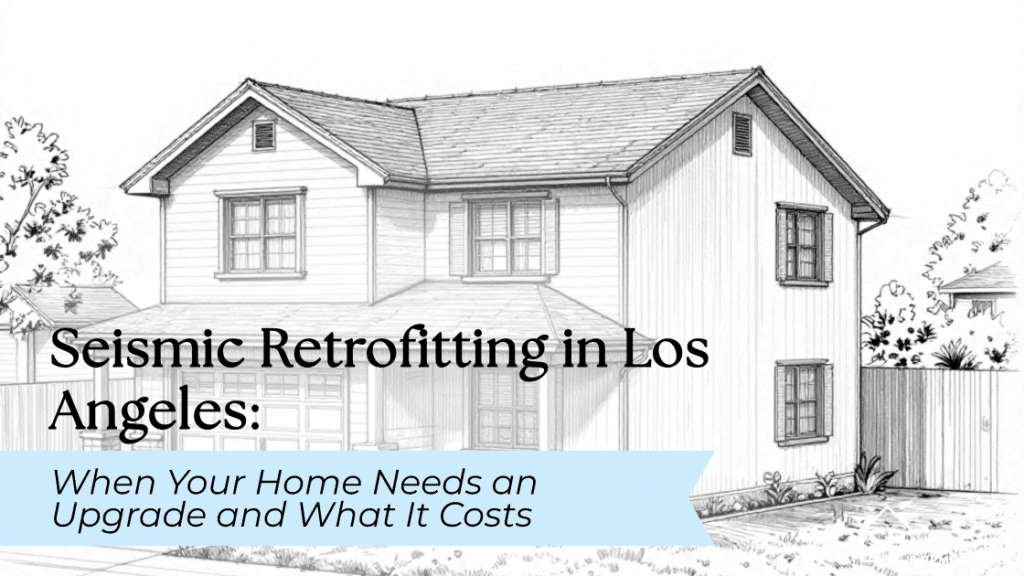
The Los Angeles region faces real earthquake risk, which is why seismic retrofitting is not just a technical upgrade. For many homeowners, it is part of protecting the structure they rely on most. In this guide, we break down what retrofitting means, how to spot the most common weak points in older LA homes, what permit path may apply, and how costs typically change from a basic brace-and-bolt job to more involved structural work.
To keep this practical and reliable, the overview below is grounded in current guidance from USGS, LADBS, FEMA, and the California Residential Mitigation Program.
Start Here: What “Seismic Retrofitting” Means for LA Homes
Seismic retrofitting means strengthening an existing home so it performs better during earthquake shaking. In Los Angeles, that usually starts at the foundation level. The goal is to reduce the chance that a wood-frame house slides off its foundation, twists at weak openings, or suffers avoidable damage at known weak points.
For many single-family homes, retrofitting is less about rebuilding the whole structure and more about reinforcing the places where older construction tends to fail first. That can include bolting the house to the foundation, bracing short crawlspace walls, strengthening a garage-level weak story, and securing heavy components like water heaters.
When Does a Home Need a Seismic Upgrade? The Most Common Red Flags
Not every house needs the same scope of work, but some signs should move a retrofit conversation higher on your priority list:
- Your home was built decades ago and has not had a documented seismic upgrade
- The first floor sits above a crawlspace or raised foundation
- There is living space over a garage or another large open-front area
- The foundation connection looks minimal, outdated, or hard to verify
- The house sits on a slope or has unusual framing conditions
- You are already opening walls or planning a major remodel
In Los Angeles, older wood-frame homes with raised foundations are among the most common retrofit candidates. If you are unsure what you are looking at, this is usually the point where a qualified contractor or engineer can save you time by identifying whether the issue is straightforward or calls for a more customized plan.
The Biggest Vulnerability in LA: Raised Foundations and Cripple Walls
One of the most common earthquake weaknesses in older Southern California homes is the raised foundation with a crawlspace below the main floor. These homes often rely on short wood-framed walls, commonly called cripple walls, between the foundation and the floor above.
If those walls are weak, poorly sheathed, or not properly anchored, the house can shift or drop during seismic movement. That is why so many retrofit conversations in Los Angeles start with crawlspace conditions rather than finishes, kitchens, or rooflines. The vulnerability is often hidden, but the fix can be highly targeted when the conditions fit a prescriptive retrofit path.
Quick Self-Check: How to Spot a Raised Foundation That Needs Bolting/Bracing
A quick visual check can help you figure out whether your home should be evaluated further:
- Are there steps up to the first floor from the exterior?
- Is there a crawlspace under the house?
- Can you see short framed walls between the concrete foundation and the floor joists?
- Do you see old or inconsistent hardware at the mudsill?
- Does the crawlspace look unfinished, lightly reinforced, or patched over time?
This is not a substitute for a real inspection, but it helps homeowners recognize when the conversation should move from curiosity to planning.
Retrofit Types Explained: Which Upgrade Fits Which Problem
Seismic retrofitting is not one-size-fits-all. The right solution depends on the house type, foundation condition, geometry, and whether the project qualifies for a standard prescriptive approach or needs engineered design.
In broad terms, most residential retrofit scopes in Los Angeles fall into three buckets: a basic brace-and-bolt retrofit for raised-foundation homes, stronger wall or opening reinforcement for more complex structural conditions, and non-structural safety upgrades that reduce secondary damage.
Option 1: “Brace + Bolt” (Cripple Wall Bracing + Foundation Anchoring)
This is the classic retrofit for many older LA homes with raised foundations. The house is anchored to the foundation, and the short crawlspace walls are reinforced with approved sheathing and hardware.
For homeowners, this is often the most efficient starting point because it addresses a major vulnerability without turning the project into a full structural overhaul. It is also the retrofit type most closely associated with grant programs like Earthquake Brace + Bolt. Typical planning budgets often fall in the low-thousands, though the final number still depends on house size, layout, labor, and whether the home truly fits the prescriptive path.
Option 2: Shear Walls and Structural Strengthening (When Basic Bracing Isn’t Enough)
Some homes need more than a basic crawlspace retrofit. If the structure has a large garage opening, a weak first story, unusual framing, split levels, tall cripple walls, or site-specific issues, the project may require engineered strengthening.
That can include shear wall work, reinforcement around openings, and other lateral upgrades designed specifically for the structure. Once a project moves into this category, budgeting usually changes. Costs rise because the work is more customized, design input becomes more important, and plan check is more likely. For homes with living space over a garage, mid-five-figure planning numbers are common enough that many owners should evaluate grant eligibility early.
Option 3: Chimneys, Water Heaters, and Non-Structural Safety Upgrades
Not every important seismic improvement is a major structural project. Securing a water heater, addressing chimney-related hazards, and reducing falling risks inside the house can materially reduce damage and disruption during an earthquake.
These upgrades are not a replacement for structural retrofitting when the home has a true foundation or weak-story issue. Still, they are often smart companion items, especially when the main goal is to reduce cascading damage such as gas leaks, water damage, broken finishes, or dangerous falling materials.
Permits in Los Angeles: When You Can Use Standard Plans vs When You Need an Engineer
Permit path matters because it affects both cost and schedule. In Los Angeles, some residential retrofit work can follow a standard plan path, while more complicated conditions require full plan check and design prepared by a licensed professional.
In practical terms, homes that fit the prescriptive criteria usually move more efficiently. Homes with special conditions, deviations, or structural complexity usually need engineering and a more customized review path. That is not necessarily a bad thing. It simply means the city wants the retrofit matched to the real condition of the house.
LADBS Standard Plan Path for Anchor Bolting + Bracing
For certain one- to three-story residential buildings with raised wood floors, LADBS allows a standard-plan-based retrofit path for anchor bolting and cripple wall bracing. This path is attractive because it is more streamlined than a fully engineered submittal.
A standard-plan route is more likely to work when:
- The building is residential and within the size and unit limits
- The perimeter has a continuous concrete footing and stem wall
- Floors are at the same elevation
- Cripple wall height stays within the allowed limits
- The project follows the standard details exactly
If those conditions are not met, the project may shift into engineer-prepared plans and formal plan check.
Inspections and Timeline: What to Expect Before Work Starts
Even relatively targeted retrofit work still has a process. First comes site evaluation and scope confirmation. Then permit preparation, submittal, and approval. After that, construction and inspection follow.
The key scheduling point is this: standard-plan jobs tend to move faster than engineered retrofits. LADBS also requires the correct plans to be available on site for inspection. For homeowners, that means the real timeline is shaped less by the physical work alone and more by how quickly the project is scoped correctly, permitted correctly, and inspected without avoidable corrections.
What Seismic Retrofitting Costs in LA: Budget Ranges by Retrofit Type
Cost depends heavily on scope, but here is a practical way to think about it:
- Basic brace-and-bolt retrofit: often around the typical low-thousands range associated with standard raised-foundation work
- Engineered structural strengthening: often notably higher, especially when large openings, soft-story conditions, or unusual geometry are involved
- Living space over garage retrofit: often the mid-five figures as a planning range, depending on location and scope
- Non-structural safety items: usually the lowest-cost category, though chimney work can vary widely
The main takeaway is simple. A clean, eligible crawlspace retrofit is very different from a custom-engineered seismic upgrade.
Real Pricing Drivers (What Actually Moves the Quote)
The quote changes when the job becomes more complex. The biggest drivers usually include the house type, size, location, labor, material needs, and whether the project stays prescriptive or becomes engineered.
Pricing also tends to rise when the house has slope conditions, taller cripple walls, unusual framing, weak garage openings, or foundation issues that are discovered after the initial review. This is why two homes of similar square footage can still receive very different seismic proposals.
Grants and Programs That Can Offset Cost (When You Qualify)
For eligible homes, grants can meaningfully improve the economics. The best-known option is the Earthquake Brace + Bolt program, which supports qualifying raised-foundation retrofits. There are also grant opportunities for certain soft-story, living-space-over-garage homes through the California Residential Mitigation Program.
If your home may qualify, check early. Grant eligibility often turns on ZIP code, foundation type, occupancy, and build characteristics. Waiting until after design decisions are made can make the process harder than it needs to be.
How to Choose a Contractor for Seismic Work (Questions to Ask)
A good retrofit bid should feel specific, not vague. Ask:
- Is this a standard-plan retrofit or an engineered one?
- What exact vulnerability is being addressed?
- What hardware and sheathing system will be used?
- Will you handle permit coordination and inspections?
- Have you completed similar Los Angeles retrofit projects?
- Are you licensed and properly insured?
- If I am pursuing a grant, are you familiar with CRMP requirements?
Before signing, use the CSLB license check and compare at least three written bids with the same scope.
Common Mistakes That Reduce Retrofit Value
The biggest retrofit mistake is assuming that partial work automatically equals meaningful protection. Other common problems include mismatched hardware, improper bolt or anchor installation, overdriven or misplaced nails, non-approved connectors, and skipping the required inspection path.
In other words, seismic work is one of those projects where details matter. A quote that looks cheaper on paper can lose value fast if the scope is incomplete or the installation does not follow the required standard.
When to Combine Seismic Work With a Remodel (Best Timing)
If you are already remodeling, retrofitting often becomes easier to stage and easier to justify. It can be especially efficient when access is improved, finishes are already being opened, or the project is part of a broader property plan.
That is also where planning matters. If you are thinking beyond retrofit work alone, you can schedule a virtual consultation or contact SB Remodeling to discuss how structural work fits into a bigger home strategy. And if the long-term plan includes added living space, SB Remodeling’s Pasadena ADU building guide and Los Angeles ADU financing options are helpful next reads because financing, permitting, and structural planning often overlap.
The Right Retrofit Depends on Foundation Type, Vulnerabilities, and Permit Path
The best retrofit is not the most expensive one. It is the one that matches the actual weakness in your home. For some Los Angeles properties, that means a straightforward brace-and-bolt upgrade. For others, it means engineered strengthening around a garage opening, slope condition, or more complex framing issue. The sooner you identify which category your home falls into, the easier it becomes to budget smartly, avoid wasted work, and make seismic improvements that genuinely add value.