Excerpt:
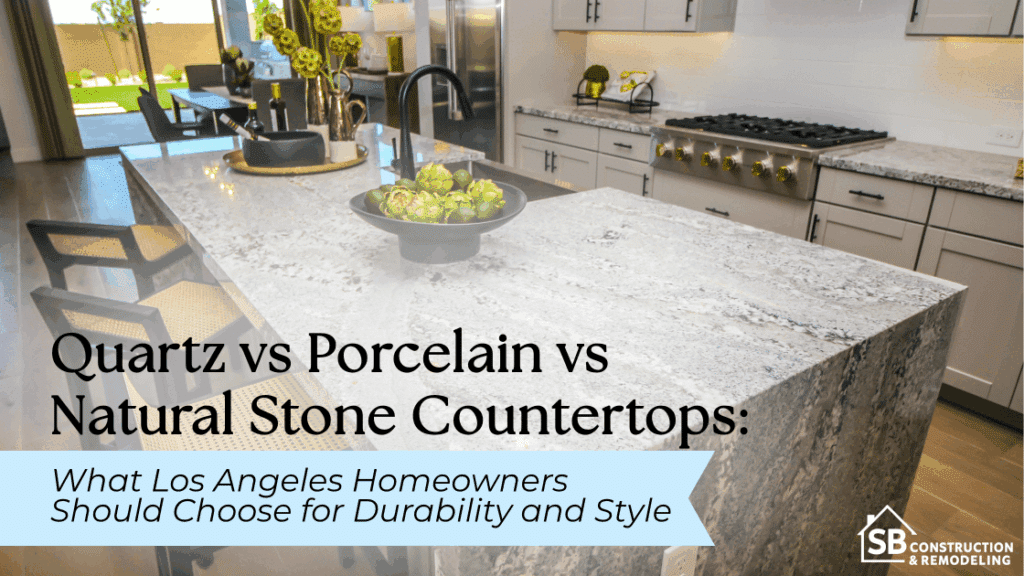
H1: Quartz vs Porcelain vs Natural Stone Countertops: What Los Angeles Homeowners Should Choose for Durability and Style
Primary keyword: quartz vs porcelain vs natural stone countertops
Suggested category: Kitchen Remodeling
Suggested author or reviewer line: SB Remodeling Editorial Team, with technical review by a qualified countertop fabricator
Suggested schema type: BlogPosting and BreadcrumbList. FAQPage may be considered only if the visible FAQ content remains on the published page and meets current search-engine eligibility requirements.
Suggested featured-image concept: A bright Los Angeles kitchen with three coordinated countertop samples or surfaces showing uniform quartz, slim porcelain, and naturally veined stone under strong natural light.
Suggested featured-image alt text: Quartz, porcelain, and natural stone countertop samples in a modern Los Angeles kitchen
Countertops influence how a kitchen or bathroom looks, but they also affect cleaning, cooking, maintenance, fabrication, and daily use. The right choice depends on more than which sample looks best in a showroom.
For many indoor Los Angeles kitchens, quartz offers the most predictable combination of consistent appearance and straightforward care. Porcelain may be a better fit for strong sunlight, high heat, thin modern profiles, or an exterior-rated installation. Natural stone is often the preferred choice when one-of-a-kind movement and authentic material character matter more than uniformity.
The final decision should account for the exact product, finish, edge profile, household habits, lighting, installation conditions, and overall remodeling scope. Homeowners planning a larger project can also review SB Remodeling’s Los Angeles kitchen remodeling services while comparing materials.
Quartz, Porcelain, and Natural Stone at a Glance
Quartz is an engineered surface made with mineral content, binders, and pigments. Porcelain countertops use large-format ceramic slabs manufactured under high heat. Natural stone is quarried material, with performance varying among granite, marble, quartzite, soapstone, and other stones.
No category is automatically best for every home. The strongest choice is the material whose appearance, maintenance needs, exposure limits, and fabrication requirements fit the project.
Quick Comparison of the Three Materials
| Material | Durability | Maintenance | Heat Resistance | Stain Resistance | Design Consistency | Typical Homeowner Fit |
| Quartz | Strong for everyday indoor use | Relatively low | Moderate; trivets recommended | Generally high | Highly consistent | Busy indoor kitchens seeking predictable color and pattern |
| Porcelain | Hard surface; exposed edges need care | Relatively low | Generally high | Generally high | Consistent printed or textured designs | Modern, sunny, or properly specified outdoor applications |
| Natural stone | Varies by stone | Low to moderate, depending on stone | Generally good, but material-specific | Varies by porosity and mineral composition | Every slab is different | Homeowners prioritizing authentic movement and natural variation |
These comparisons are category-level guidance. Product specifications, finish, thickness, fabrication quality, and installation details can materially change performance.
Which Countertop Material Is Best for Each Priority?
- Easiest routine care: Quartz or porcelain
- Strongest natural character: Natural stone
- Strong sunlight or outdoor exposure: An exterior-rated porcelain product
- Controlled color and pattern: Quartz
- A surface that develops patina: Marble or soapstone
- A thin contemporary profile: Porcelain
Quartz Countertops: Consistent Style and Straightforward Maintenance
Quartz is often practical for busy households because most products are highly nonporous, resist common spills, and do not require the periodic sealing associated with some natural stones. Its controlled manufacturing also produces more consistent color and veining between samples and installed slabs.
Quartz is not maintenance-free or damage-proof. Homeowners should follow the exact manufacturer’s cleaning, heat, and warranty instructions rather than assuming all engineered quartz performs identically.
Where Quartz Performs Best
Quartz works particularly well in indoor kitchens, bathroom vanities, laundry areas, and other spaces where predictable appearance and simple cleaning are priorities. Warm water, mild soap, and a soft cloth are typically suitable, although homeowners should confirm the approved products for their selected surface.
Its consistency can also make it easier to coordinate multiple countertop runs, backsplashes, and adjoining rooms.
Quartz Design Options for Contemporary and Transitional Homes
Quartz is available in solid colors, subtle concrete-inspired finishes, and printed patterns that reference marble or other stones. It supports clean contemporary kitchens as well as transitional interiors that combine modern finishes with traditional cabinetry.
SB Remodeling’s Kitchen Upgrade in Altadena provides an example of how updated countertops, cabinetry, and appliances can be coordinated within an existing kitchen layout.
Limitations Los Angeles Homeowners Should Consider
Direct or sustained heat may damage quartz or affect its appearance, so trivets or insulated pads should be used beneath hot cookware and countertop appliances. Strong chemicals and abrasive products may also harm certain finishes.
Sunlight exposure is product-specific. Some quartz warranties exclude UV exposure and outdoor installations, making standard quartz a less predictable choice near intense direct sun or in an exterior kitchen unless the exact product is rated for that use.
Porcelain Countertops: Thin Profiles, Heat Resistance, and Modern Design
Porcelain can be more versatile than quartz where heat, sunlight, or exterior exposure is a major concern, provided the selected product is approved for the intended application. Gauged porcelain slabs are large ceramic panels manufactured to a defined thickness for uses such as walls, floors, and countertops.
The main tradeoff is that the hard surface can have comparatively vulnerable edges and requires experienced handling and fabrication.
Why Porcelain Works Well in Modern Los Angeles Homes
- It can create a slim, minimal countertop profile.
- It generally handles heat better than engineered quartz.
- Many porcelain products offer strong stain and UV resistance.
- Printed surfaces can reproduce stone, concrete, metal, or solid-color looks.
- Exposed edges and cutouts may chip under concentrated impact.
Porcelain may suit contemporary kitchens with flat-panel cabinetry, integrated backsplashes, and large-format surfaces.
Indoor and Outdoor Applications
Porcelain can be used in kitchens, bathrooms, wall cladding, fireplace surrounds, and other compatible assemblies. Certain manufacturer-rated collections are also suitable for exterior kitchens and direct sunlight.
Outdoor suitability should never be assumed from appearance alone. Confirm the product’s UV rating, temperature limitations, substrate requirements, warranty, and approved installation methods.
Fabrication, Edges, and Installation Considerations
Large porcelain slabs require careful transportation, cutting, and support. Sink openings, cooktop cutouts, corners, and mitered edges should be planned before fabrication.
The current ANSI standards for gauged porcelain tile panels and slabs include product and installation criteria relevant to countertop applications. Homeowners should use a fabricator familiar with the selected product, thickness, backing, adhesive system, and substrate.
Natural Stone Countertops: Unique Character and Material-Specific Performance
Natural stone is a category, not one uniform material. Each stone has its own mineral composition, porosity, hardness, acid sensitivity, and maintenance needs. Even slabs sold under the same commercial name may show meaningful differences.
Inspect the full slabs before fabrication. Review fissures, resin-filled areas, veining, shade variation, seam placement, and bookmatching. Bookmatching means arranging adjoining slabs so their veining forms a mirrored pattern.
Granite for Reliable Everyday Performance
Granite is a hard natural stone commonly selected for heavily used countertops. It generally offers strong abrasion and heat resistance, although sudden temperature changes and concentrated impacts can still cause damage.
Absorption and sealing needs vary by slab. Confirm maintenance requirements with the stone supplier and fabricator.
Marble for Timeless Veining and Patina
Marble offers distinctive veining and a softer visual character that can complement traditional, Mediterranean-inspired, and contemporary interiors. Because marble contains acid-sensitive minerals, citrus, wine, vinegar, and some cleaners can cause etching.
Etching is a dull or discolored area caused by a chemical reaction. Homeowners selecting marble should be comfortable with careful maintenance and the patina that may develop over time.
Quartzite for Natural Stone Beauty and Strength
Quartzite is a natural metamorphic stone and should not be confused with engineered quartz. Many quartzites provide dramatic movement with strong abrasion resistance, but commercial naming can be inconsistent.
Ask the supplier to confirm the stone’s classification, recommended care, sealing needs, and suitability for the planned application.
Soapstone and Other Specialty Stones
Soapstone is softer than granite or quartzite, so scratches and visible wear are more likely. It is also known for heat and chemical resistance and may appeal to homeowners who appreciate a surface that changes with use.
Limestone, onyx, slate, and other specialty stones require similarly material-specific evaluation.
Durability Comparison: Scratches, Chips, Heat, Stains, and Sunlight
Durability should be evaluated by type of exposure rather than through one overall ranking.
| Material | Scratches | Heat | Common Stains | Sunlight | Edge Impact |
| Quartz | Good | Moderate | Very good | Product-specific | Good, but not chip-proof |
| Porcelain | Very good surface resistance | Very good | Very good | Very good when exterior-rated | Exposed edges require care |
| Granite or quartzite | Generally very good | Generally very good | Varies by slab and care | Generally good | May chip under concentrated impact |
| Marble | Moderate | Good | Etching and staining possible | Product-specific | May chip or scratch |
| Soapstone | Scratches relatively easily | Very good | Generally good | Product-specific | Softer edges may show wear |
Scratch and Abrasion Resistance
Porcelain, granite, and many quartzites generally resist everyday abrasion well. Quartz is also scratch-resistant, but no countertop should be treated as a permanent cutting board.
Heat and Sunlight Exposure
Porcelain and many natural stones generally tolerate heat better than engineered quartz. Trivets remain sensible because thermal shock, adjacent sealants, seams, and cabinetry may have different limits.
Stains, Etching, and Moisture
Quartz and porcelain generally resist household spills well. Natural stone performance varies, and marble can etch even when a sealer has been applied because sealing does not prevent an acid reaction.
Chips, Cracks, and Edge Damage
Fabrication quality, support, cutout geometry, seam placement, overhangs, and edge profiles affect real-world durability. Rounded or eased edges may conceal minor impacts better than very sharp profiles.
Maintenance Requirements and Long-Term Appearance
A practical maintenance plan should be based on the exact product rather than a generic countertop label.
- Quartz: Use mild soap, soft cloths, trivets, and manufacturer-approved cleaners.
- Porcelain: Clean with mild detergent, remove residue, and protect exposed edges from hard impact.
- Natural stone: Use a neutral cleaner and follow stone-specific sealing and stain-removal guidance.
Daily Cleaning by Material
Avoid abrasive pads, unknown solvents, and acidic cleaners unless the manufacturer expressly approves them. The Natural Stone Institute’s care guidance explains why calcareous stones such as marble require different cleaning products from many siliceous stones.
Sealing and Periodic Maintenance
Quartz and porcelain generally do not require sealing. Natural stone may or may not require it, depending on absorption, finish, use, and sealer compatibility. A fabricator can perform or recommend an absorption test rather than relying on a universal schedule.
Which Materials Age Gracefully?
Natural stone often shows wear as patina, which some homeowners value. Uniform quartz may make isolated damage more noticeable, while strongly patterned surfaces can visually soften minor marks. Porcelain tends to retain its printed appearance, but edge chips may expose a different body color depending on the product.
Style Comparison: Matching the Countertop to the Home
Countertops should be coordinated with cabinetry, flooring, wall color, backsplash material, plumbing fixtures, appliance finishes, and the amount of natural light in the room.
Contemporary and Minimalist Kitchens
Quartz and porcelain both support controlled patterns, monochromatic palettes, and clean lines. Porcelain is especially useful when the design calls for a thin edge or matching countertop and wall surfaces.
Spanish Revival and Mediterranean-Inspired Homes
Warm granite, expressive quartzite, marble, or a carefully selected stone-look surface can complement plaster textures, wood cabinetry, handmade tile, and aged-metal finishes. The material should reinforce the architecture without making the room feel overly themed.
Mid-Century Modern Interiors
Restrained quartz, soapstone, terrazzo-inspired porcelain, and lightly patterned natural stone can work with flat-front cabinetry and warm wood. The goal is often visual clarity rather than highly decorative veining.
SB Remodeling’s kitchen and bath renovation in Los Feliz shows how coordinated cabinetry, tile, fixtures, and finishes can create continuity across multiple rooms.
Statement Islands and Waterfall Edges
A waterfall edge continues the countertop material vertically down the side of an island. Slab dimensions, vein direction, pattern alignment, edge construction, seam placement, and fabrication yield should be reviewed before ordering.
Los Angeles-Specific Factors That Can Influence Your Choice
Los Angeles does not require one particular countertop material, but local homes commonly present design and installation conditions that affect the decision:
- Strong natural light and west-facing windows
- Indoor-outdoor entertaining areas
- Narrow lots, stairs, elevators, or restricted delivery access
- Older cabinets or uneven existing conditions
- Large islands requiring careful support and seam planning
Natural Light and Sun Exposure
View samples vertically and horizontally in the home at different times of day. Bright Southern California sunlight can make subtle colors, gloss levels, printed patterns, and seam transitions look different than they did under showroom lighting.
Indoor-Outdoor Living and Exterior Kitchens
For an exterior kitchen, verify UV resistance, thermal performance, water exposure, freeze-thaw suitability where relevant, and warranty coverage. Exterior-rated porcelain is often a strong candidate. Standard engineered quartz should not be specified outdoors without written manufacturer approval.
Slab Selection, Fabrication, and Installation Access
Confirm that the selected slab can be delivered through the available path and installed without unsafe handling. Large islands, unsupported overhangs, heavy assemblies, and existing cabinetry may require project-specific support evaluation.
Cutting and grinding engineered and natural stone can create hazardous respirable silica dust. Fabrication should be performed by qualified professionals using appropriate controls consistent with OSHA’s countertop-fabrication safety guidance.
How to Choose the Right Countertop for Your Household
Use this decision process:
- Identify where the surface will be installed and how much sun, heat, moisture, and impact it will receive.
- Decide how much maintenance and visible patina you will accept.
- Compare full slabs or large samples under the home’s lighting.
- Review fabrication, warranty, support, seam, and care requirements before approving the order.
Choose Quartz If You Prioritize Consistency and Easy Care
Quartz is often the best fit for indoor households seeking predictable patterns, broad design choices, and relatively simple daily maintenance.
Choose Porcelain If You Prioritize Heat, Sunlight, and a Modern Profile
Porcelain may be the better option for a thin contemporary look, strong sunlight, heat exposure, or an exterior installation using an appropriately rated product.
Choose Natural Stone If You Prioritize Authenticity and Unique Character
Natural stone is often worth the additional selection and care considerations when the homeowner values genuine variation, depth, movement, and a surface that can develop character over time.
Compare Countertop Slabs Before Finalizing Your Los Angeles Remodel
Do not approve countertops based only on a small sample. The final slab, edge, finish, seams, backsplash, sink, faucet, cabinetry, and appliances should be planned as one coordinated assembly.
Countertop Selection Checklist
Before ordering, confirm:
- Full-slab appearance and variation
- Finish and approved cleaning products
- Slab thickness and edge profile
- Seam locations and vein direction
- Sink and cooktop cutouts
- Backsplash height and outlet coordination
- Overhang and support requirements
- Indoor or exterior approval
- Product and fabrication warranty terms
- Delivery and installation access
Plan Your Countertops With the Full Remodel in Mind
Countertop dimensions depend on finalized cabinetry, appliance specifications, plumbing locations, wall conditions, and field measurements. Reviewing SB Remodeling’s project-planning process can help homeowners understand why materials should be coordinated before fabrication deadlines.
Permitting depends on the jurisdiction and complete scope, not simply the countertop material. In the City of Los Angeles, some nonstructural kitchen or bathroom remodels may qualify for an express permit, while structural changes, layout modifications, and electrical or plumbing work may require additional permits or plan review. Homeowners should consult the LADBS homeowner guide. Properties outside the City of Los Angeles may fall under Los Angeles County Public Works or another incorporated city.
Homeowners can browse completed remodeling projects for design references or schedule a virtual consultation to discuss the kitchen or bathroom’s goals, preliminary scope, lighting, materials, and next planning steps.
Frequently Asked Questions
Which countertop material is the most durable?
There is no single winner in every durability category. Porcelain generally performs strongly against scratches, stains, heat, and sunlight, but exposed edges can be vulnerable. Quartz performs well in busy indoor kitchens but needs heat and UV precautions. Granite and quartzite can provide strong natural-stone performance, subject to the exact slab and installation.
Is porcelain better than quartz for an outdoor kitchen in Los Angeles?
An exterior-rated porcelain product is generally more suitable than standard quartz for an outdoor kitchen because porcelain products are available with UV, heat, and weather exposure ratings. Confirm the exact product’s technical documentation and warranty. Shade structures, substrates, appliances, drainage, and installation details also affect the complete outdoor assembly.
Do all natural stone countertops need to be sealed?
No. Sealing requirements vary by stone type, porosity, finish, location, and intended use. Some dense stones may absorb very little, while other slabs benefit from a compatible penetrating sealer. The supplier or fabricator should evaluate the actual slab rather than assigning every natural stone the same maintenance schedule.
Does replacing a countertop require a permit in Los Angeles?
It depends on the jurisdiction and the surrounding work. A direct countertop replacement without structural or trade changes may follow a simpler path, while relocating a sink, changing electrical circuits, modifying walls, or altering structural support may trigger permits or plan review. Confirm the requirements with the agency serving the property address before work begins.
What is the difference between quartz and quartzite?
Quartz countertops are engineered surfaces made with mineral content, binders, and pigments. Quartzite is a quarried natural stone formed through geological processes. Quartz provides more consistent design and generally does not require sealing. Quartzite offers natural variation, but its porosity, care needs, and performance should be confirmed for the exact slab.
Match the Material to the Household
The quartz vs porcelain vs natural stone countertops decision should begin with how the room will actually be used. Quartz is often the practical indoor choice, porcelain is compelling for modern profiles and demanding exposure, and natural stone offers unmatched variation.
Compare full slabs, review technical documentation, confirm fabrication details, and coordinate the selection with the entire kitchen or bathroom plan before ordering.