
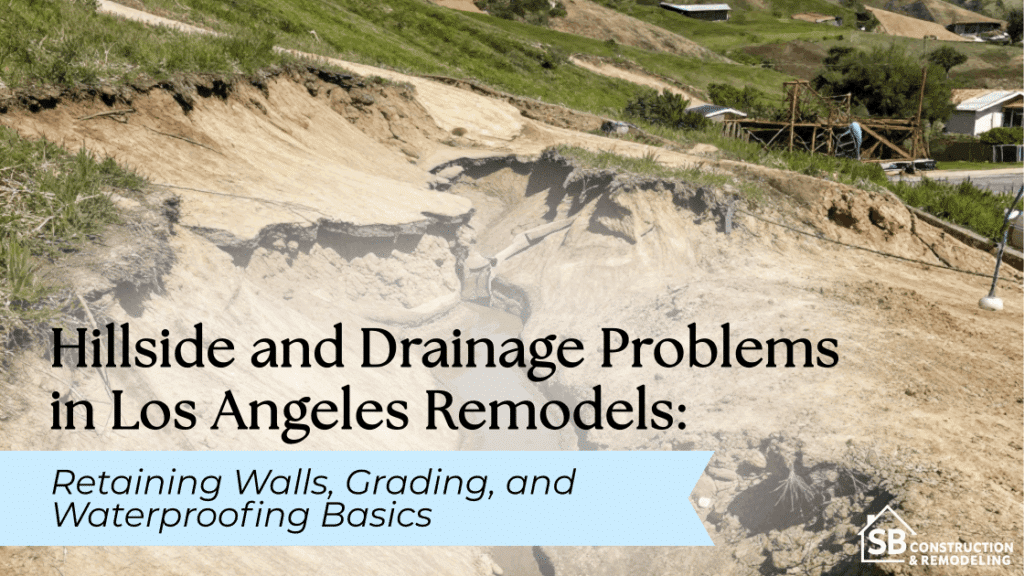
California has dealt with dozens of billion-dollar weather and climate disasters in recent decades, and when heavy rain hits Southern California, hillside properties can quickly reveal weaknesses that have remained hidden during dry months. That is why drainage issues in Los Angeles remodels deserve attention early, especially when you are dealing with slopes, retaining walls, or below-grade spaces.
In this guide, we will walk through the warning signs, explain the causes of water intrusion on hillside lots, and break down the basics of grading, waterproofing, and permitting that homeowners should understand before construction begins.
Throughout the article, we also point you to reliable resources such as LADBS, the City of Los Angeles Stormwater Program, the U.S. Geological Survey, and the EPA’s moisture guidance so you can make decisions based on current, trustworthy information.
Start Here: Why Hillside Drainage Problems Get Expensive Fast in Los Angeles
On a flat lot, water may just pond and create nuisance issues. On a hillside lot, that same water can move fast, collect behind walls, saturate soil, erode slopes, and push against foundations. Once that happens, what looked like a minor drainage annoyance can turn into structural repair, waterproofing, engineering, and permit work all at once.
That is why the smartest approach is usually not to “patch the leak,” but to understand how water is moving across and under the site.
The Biggest Warning Signs (What Homeowners Notice First)
Most homeowners do not start with a soils report. They start with symptoms. Common early clues include:
- water pooling near the foundation or at the bottom of a slope
- damp crawlspaces or musty odors after rain
- white mineral residue on concrete, masonry, or stucco
- cracks in stucco, drywall, or hardscape that keep returning
- doors that suddenly stick or floors that feel slightly out of level
- staining, bubbling paint, or repeated moisture at the same wall or slab edge
- retaining walls that lean, bulge, or show movement
When more than one of these is happening at the same time, it is usually a sign that water management, not just finish repair, needs attention.
Step 1: Identify the Water Source and Flow Path (Surface vs Subsurface)
Before anyone talks about drains, membranes, or wall reconstruction, identify whether the problem is surface water, subsurface water, or both.
Surface water usually comes from roof runoff, patio runoff, driveway runoff, or uphill yard drainage that is not being collected and redirected properly. Subsurface water is trickier. It may be hillside seepage, groundwater movement, or water trapped behind a wall or slab edge.
If the source is misdiagnosed, the fix often fails. A French drain will not solve a bad downspout layout by itself, and interior waterproof coating will not solve water pressure building outside the wall.
Grading Basics: The “Slope Away From the House” Rule and Where It Breaks on Hillsides
At the most basic level, finished grade should move water away from the house, not toward it. That sounds simple, but hillside sites often limit how much room you have to create ideal drainage slopes. Tight setbacks, stepped yards, hardscape, and existing retaining walls can all interrupt the clean “slope away” rule.
On these properties, good grading often means combining modest surface slope with swales, drains, and controlled discharge points. If your lot does not allow enough horizontal run to move water naturally, you usually need a more coordinated drainage plan rather than more guesswork.
Retaining Walls 101: When You Need One (and What It Must Do)
A retaining wall is not just a landscape feature. It is a structural element that holds back soil where grade changes would otherwise fail or erode. On Los Angeles hillside remodels, retaining walls often serve multiple jobs at once: stabilize grade, create usable yard area, protect foundations, and help manage runoff.
A properly designed retaining wall is not just about concrete or block strength. It also has to account for soil pressure, water pressure, backfill conditions, and discharge. That is why the drainage behind the wall matters almost as much as the wall itself.
When Retaining Walls Need Permits (Height and Surcharge Concepts)
In Los Angeles, retaining wall permit triggers are more nuanced than many homeowners expect. The common rule of thumb is that walls over 4 feet can trigger permit requirements, but that is not the whole story. A wall can also lose its exemption if it supports a surcharge, sloping earth, or sits on steep slope conditions.
In practical terms, that means a wall that seems “small” may still require review if it is doing real structural work on a hillside lot. If your remodel includes cuts, backfill, or wall work near a slope, it is smart to treat permit review as part of the plan from the beginning.
Waterproofing vs “Water Management”: What Actually Stops Leaks
Many homeowners use the word waterproofing to describe every moisture fix. In reality, water management is the bigger concept.
Waterproofing products like membranes, sealants, or coatings help resist moisture at the building edge. Water management is what reduces the amount of water that reaches that edge in the first place. That includes grading, drains, gutters, downspout routing, drainage board, flashing, and controlled discharge.
The best projects use both. If you only coat the wall but leave the site drainage unchanged, the pressure and moisture load usually remain.
Common Failure Points in Hillside Remodels
The repeat offenders are surprisingly consistent:
- missing drainage behind retaining walls
- clogged subsurface drains or no cleanouts
- downspouts dumping too close to the house
- negative grading at planters, patios, or slab edges
- unsealed penetrations where utilities pass through walls
- poor flashing transitions at doors, decks, and wall intersections
- trying to solve exterior water with interior patch products alone
These failures are especially common when drainage work gets split across trades without one coordinated site plan.
Drainage Solutions That Usually Work (Matched to the Problem)
Not every water issue needs the same fix. Matching the tool to the cause matters.
- Pooling surface water near hardscape: area drains, channel drains, regrading, or swales
- Roof runoff concentrated at the base of walls: gutters, larger downspout capacity, solid pipe extensions, controlled discharge
- Water moving through soil on the uphill side: subsurface collection systems such as French drains or curtain drains
- Low spots with no gravity outlet: sump systems or engineered discharge strategies
- Erosion across open slope areas: grading correction, drainage swales, and erosion-control measures
- Water trapped behind walls: backdrain systems, drainage rock, filter fabric, and a proper outlet path
The important point is that drains are not interchangeable. A beautiful new trench drain does very little if the real problem is hillside seepage behind the retaining wall.
Retaining Wall Drainage Details That Prevent Hydrostatic Pressure
Retaining wall performance depends heavily on what happens behind the wall. Common details include free-draining gravel backfill, perforated collection pipe at the base, filter fabric to limit clogging, and outlet paths that actually move water away from the structure. Some wall systems also use weep holes or other drainage openings depending on design.
This is where engineering judgment matters. The goal is not simply to let some water out. The goal is to prevent pressure buildup and long-term saturation that can shorten the life of the wall.
Roof + Site Drainage: Gutters, Downspouts, and Where the Water Should Go
A hillside property can have a perfectly built wall and still fail if the roof drainage is careless. Gutters and downspouts should be treated as part of the site drainage system, not an afterthought.
Water should be collected, routed, and discharged in a way that keeps it away from the foundation, slope face, and wall backfill zones. Splash blocks alone are rarely enough on challenging hillside lots. In many cases, solid piping to a safer discharge point is the better move.
Waterproofing Details Around the House: Foundations, Slabs, and Transitions
The vulnerable areas are usually not the broad wall surfaces. They are the transitions. Think slab edges, stem walls, cold joints, utility penetrations, door thresholds, and changes between deck, planter, wall, and grade.
Exterior waterproofing assemblies typically work best when they are continuous and tied together thoughtfully. If one transition is left exposed or poorly flashed, water often finds it. This is also why isolated crack sealing can be helpful but may not be enough when moisture is coming from multiple paths.
Stormwater and LID: Why Some LA Projects Trigger Extra Requirements
Some Los Angeles projects also run into stormwater review under the city’s Low Impact Development program. If your remodel creates, adds, or replaces enough impervious area, the city may require stormwater mitigation measures as part of design and plan review.
That can affect paving choices, drainage layouts, capture strategies, and how runoff is handled on site. Features like permeable surfaces, rainwater capture, or bioretention strategies can sometimes become part of the compliance conversation, depending on project scope.
Permits and Plan Check Reality in Los Angeles (Grading + Retaining + Drainage)
Once drainage work starts involving hillside grading, wall cuts, recompaction, slope repair, or substantial backfill, the review process can become more technical. LADBS grading review is not just about paperwork. It can involve plan check, soils or geology input, and inspection sequencing that affects the whole construction schedule.
For homeowners, the practical takeaway is simple: do not assume drainage work is “minor” just because much of it ends up buried.
When You’ll Likely Need Geotechnical/Engineering Help
You should expect engineering or geotechnical input sooner rather than later when:
- the site is steep or actively moving
- retaining walls are structural, tall, or near slopes
- there is visible wall movement or slope distress
- fill, recompaction, or major excavation is involved
- the source of water appears to be hillside seepage rather than simple runoff
- the scope includes new foundations, large hardscape, or significant grade changes
On many hillside projects, engineering is what keeps a drainage fix from becoming a temporary repair.
Timeline: What to Expect Before Construction Starts
The pre-construction phase often takes longer than homeowners hope. A realistic sequence usually looks like this: site evaluation first, then survey or field verification as needed, then engineering or geotechnical input, then plans, then permit review, then construction scheduling.
Simple drainage corrections can move faster. But once a project includes retaining walls, grading review, or soils reports, lead times usually expand. That makes early planning especially important if you are trying to line up your remodel with other work.
Cost Drivers: What Changes the Budget Most
The budget usually moves most when the project shifts from visible symptoms to hidden causes. Cost drivers often include excavation difficulty, access for equipment, export and haul-off, retaining wall height and complexity, waterproofing scope, drainage discharge path, engineering, soils work, and permit requirements.
In other words, the biggest pricing difference is often not material selection alone. It is how much site correction the property actually needs.
Mistakes to Avoid (That Create Repeat Water Problems)
The most expensive mistakes are usually the ones that make the same water problem come back:
- fixing interior damage without correcting exterior drainage
- installing drains with no cleanout or maintenance plan
- sending water right back toward the slope or wall
- ignoring early retaining wall movement
- assuming waterproof paint is the same thing as waterproofing
- skipping permits or engineering on hillside work that clearly needs both
A successful repair is usually coordinated, not piecemeal.
Hiring Checklist: Questions to Ask a Contractor on Hillside and Drainage Work
Before hiring anyone, ask questions that force the scope to become specific:
- What do you believe the primary water source is?
- Are you proposing a surface-water fix, a subsurface-water fix, or both?
- How will roof drainage tie into the site plan?
- What is the intended discharge path?
- Will the retaining wall drainage be shown in plan?
- Do you expect structural engineering or geotechnical review?
- What permits are likely required?
- How will waterproofing transitions be handled at penetrations and thresholds?
- Will there be cleanouts and future maintenance access?
- What warranty applies to drainage versus finish work?
If you want help evaluating your site, you can schedule a virtual consultation or contact SB Remodeling to talk through the property conditions before small issues turn into larger repairs.
The Best Hillside Fix Is a Coordinated Plan (Grading + Drainage + Waterproofing)
The best hillside drainage solution is rarely just a drain, just a wall, or just a membrane. It is a coordinated plan that manages runoff, protects the structure, and respects the realities of Los Angeles permitting and slope conditions. If your drainage concerns are part of a larger property upgrade, SB Remodeling’s resources on the Pasadena ADU building guide and Los Angeles ADU financing options can also help you think through broader planning and budget decisions. The earlier the problem is diagnosed correctly, the more likely it is that your remodel stays dry, stable, and worth the investment.