
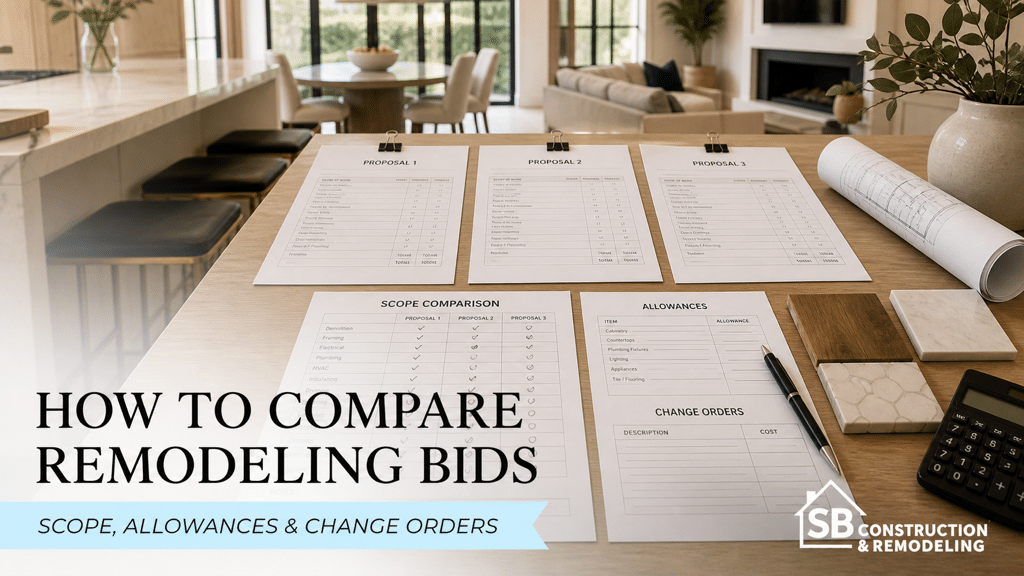
To compare remodeling bids fairly, make every contractor price the same scope, then review allowances, exclusions, assumptions, change-order rules, payment schedules, permits, and closeout requirements. The lowest total is not automatically the best value. It may exclude work, carry smaller allowances, assume fewer repairs, or leave important decisions unresolved. A useful comparison asks what each price includes and what could change it.
In California, home improvement contracts also carry specific consumer requirements. Use current Contractors State License Board guidance before signing, and seek legal advice for contract questions that require it.
A Lower Total May Describe Less Work
Contractors can walk through the same home and return with different numbers because they made different assumptions. One may include permits, protection, detailed waterproofing, painting, and debris removal. Another may price only visible construction and treat the rest as owner responsibility or future changes.
The first comparison is therefore not price versus price. It is scope versus scope.
Ask each bidder to explain:
- What drawings and specifications were used?
- Which labor and materials are included?
- Which selections are fixed and which are allowances?
- What existing-condition assumptions were made?
- What is excluded or assigned to the owner?
- How are permits, inspections, changes, and closeout handled?
Normalize Every Bid Into One Comparison Table
Create one master scope and place every proposal beside it. If a line item is missing, mark it as “not stated,” not zero. This exposes gaps without assuming the contractor intended to include them.
| Scope category | Bid A | Bid B | Question or gap |
|---|---|---|---|
| Design, plans, and engineering | Who prepares and coordinates required documents? | ||
| Permits and fees | Included, allowance, reimbursable, or owner-paid? | ||
| Demolition and disposal | What materials and haul-away are included? | ||
| Structural and rough trades | What repairs or upgrades are assumed? | ||
| Waterproofing and substrates | Which system and preparation are specified? | ||
| Finish materials | Fixed products or allowances? | ||
| Protection, cleaning, and closeout | What happens before final payment? |
Include details such as paint areas, tile limits, cabinet panels, trim, hardware, appliance connections, fixture installation, site protection, temporary services, inspections, punch-list work, warranties, and documentation. A line called “complete bathroom” is not a substitute for a defined scope.
If the design is still changing, compare proposals again after major decisions are settled. Otherwise, each contractor may be pricing a different interpretation of an unfinished plan.
Read Allowances as Unfinished Decisions
An allowance is an amount reserved for an item that has not been fully selected or quantified. It can help a project move forward, but it is not the same as a fixed product specification.
For every allowance, ask:
- What exact category does it cover?
- Is it for material only or installed cost?
- Are tax, freight, delivery, accessories, waste, and labor included?
- What products currently fit within it?
- How is the difference handled if the final selection is above or below the allowance?
A tile allowance that covers tile material but not setting materials, trim pieces, delivery, waste, or installation should not be compared with a fully installed tile scope. A cabinet allowance may exclude panels, trim, hardware, freight, or installation. Normalize the definition before comparing the amount.
Whenever possible, make important selections before final pricing. A named product, model, finish, and installation requirement reduces ambiguity.
Separate Assumptions, Exclusions, and Alternates
Assumptions describe what the contractor believes to be true. Exclusions describe work or cost outside the proposal. Alternates are optional scope changes with separate pricing. These categories should not be buried in general notes.
Common assumptions
- Existing framing or substrate is sound
- Electrical service has adequate capacity
- Existing plumbing can accept the proposed work
- No hazardous or regulated material will be disturbed
- Work can occur during stated access hours
Common exclusions
- Permit or plan-check fees
- Engineering or specialty consultants
- Owner-supplied fixtures and appliances
- Hidden-condition repairs
- Painting outside the immediate work area
- Temporary housing, storage, or utility costs
Exclusions are not automatically a problem. Unclear exclusions are. Assign each item to the contractor, owner, designer, supplier, or another responsible party so it does not become an emergency later.
Require a Written Change-Order Path
A change order modifies the agreed scope, price, or schedule. California’s CSLB states that changes to a home improvement contract must be in writing. Its contractor guidance explains that a change order should describe the extra work or change, the amount added or subtracted, and the effect on the progress-payment schedule, and that it becomes part of the contract when signed before the changed work begins.
The contract should explain:
- Who can request a change
- How the scope and reason are documented
- How labor, material, overhead, and other pricing are presented
- How schedule impact is shown
- Who must approve the change and when work may proceed
- How urgent concealed conditions are stabilized while approval is obtained
Hidden conditions are not a reason to abandon documentation. The team should record what was found, why it differs from the contract assumption, what options exist, and how each option changes cost and schedule.
Clear change management is also part of an organized remodeling process. Decisions should be traceable from design through construction and closeout.
Evaluate the Payment Schedule and California Contract Basics
CSLB states that California requires a written contract for home improvement projects over $500. The contract should describe the products, work, materials, cost, necessary permits, and completion information. CSLB also states that the down payment generally cannot exceed $1,000 or 10 percent of the contract price, whichever is less, excluding finance charges, subject to the current rules and limited listed exceptions.
A detailed progress-payment schedule should connect payments to work or materials. CSLB advises that payments cannot exceed the value of work performed, except for the permitted down payment. Review the current official guidance for the exact project and contract.
Before signing, verify:
- The contractor’s license and business information
- The complete written scope and material description
- Start and completion information
- The permit responsibility
- The progress-payment schedule
- Required notices and cancellation information
- Change-order procedures
- Warranty language
- Insurance and other project-specific documents
Use CSLB’s official home improvement contract guidance and license lookup rather than relying on a generic online checklist.
Score Clarity, Not Just Price
After normalizing the bids, score each proposal on the factors that affect delivery:
- Scope completeness: Is the work described in enough detail to administer?
- Selection clarity: Are products fixed or supported by realistic allowances?
- Risk transparency: Are assumptions and exclusions visible?
- Change control: Is the written process clear?
- Payment logic: Do payments follow completed work and current law?
- Schedule credibility: Are permits, procurement, inspections, and dependencies addressed?
- Communication: Does the team answer questions directly and revise the proposal accurately?
A clear bid makes it easier to manage decisions and identify genuine changes. Ambiguity may look flexible at signing but often shifts decisions and cost into construction.
Choose the Proposal You Can Administer
The strongest remodeling bid is not simply a total. It is a usable project document with a complete scope, understandable allowances, visible exclusions, lawful payment terms, and a written path for changes. To develop a defined Los Angeles remodeling scope before comparing proposals, contact SB Remodeling.
Frequently Asked Questions
Why are two remodeling bids so different?
They may include different work, products, allowances, repairs, permits, assumptions, overhead, schedules, or risk. Normalize each line item before comparing totals.
Is the lowest remodeling bid a red flag?
Not automatically. It becomes concerning when the scope is incomplete, the allowances are unrealistic, important terms are vague, or the price cannot be reconciled with the work.
Should change orders be in writing?
Yes. CSLB states that changes to California home improvement contracts must be in writing. Review current official requirements and make sure approval occurs before changed work begins.
What is a reasonable allowance?
An allowance is reasonable when products that meet the project’s requirements are actually available within it and the proposal clearly states whether tax, delivery, accessories, waste, and installation are included.
How should progress payments be structured?
They should be written, understandable, connected to work or materials, and compliant with current California requirements. CSLB states that payments generally cannot exceed the value of work performed, except for the lawful down payment.
This article provides general educational information and is not legal advice. California contract requirements and exceptions can change. Review current CSLB materials and consult a qualified attorney for advice about a specific contract or dispute.